English

German

Chinese
Home About us Products Catalogues Services R & D Jobs
News Contact us


Markets of ChenYang Products
Quality & Environment
Research & Development Works
 Sensors & Transducers
 Magnetics & Measuring Instruments
 Measurement Technology
 Digital Signal Processing
Publications
 List of books
 List of Journal Papers
 List of Conference Papers
Self-mixing interferometry for speed measurement
 Open loop Hall-Effect current sensors
 Optical Reflective Gear Tooth Sensor
 Method for Measuring Current Derivative Signal
 Rotational Speed Measuring and Calibration System
 Thermal drift of open-loop Hall Effect current sensor
 Direction Detection Based on the Output Duty Cycle
 Optimization of Conductor Structural Parameters
 Offset Error reduction in Hall Current Sensors
 Zero Offset Reduction in Hall Effect Sensors
 Error Correction of Automatic Testing Systems
 Design of Hall Effect Gear Tooth Speed Sensors
 Error Compensation of Hall Effect Current Sensors
 Parameter Optimization of Hall Gear Tooth Sensors
 Split Core Closed Loop Hall Current Sensors
 Mathematical Models of Gear Tooth Sensors
 Accuracy Improvement in Measuring & Test Systems
 Frequency-selective Adaptive Filtering
 Inductive eddy current sensors for stress measurement
 Fiber optic Bragg-grating sensors
 Capacitive Sensors for Displacement Measurement
 Self-calibration measuring methods
 Precise impedance measurement
 Measuring system of position transducers
 Self-correction algorithms
 Frequency selective-adaptive filtering
 Precise Fourier-analysis
 Parameter determination of damped oscillation signals
Competent Team
 Dr.-Ing. habil. Jigou Liu
 M.Sc. Jane Chen


High Sensitive Magnetoelastic Sensors
for Measurements of Mechanical Quantities


Magnetoelastic sensors are very sensitive for measurements of mechanical vibration, shock, strain, force and acceleration etc. This is shown in the following experiments results.
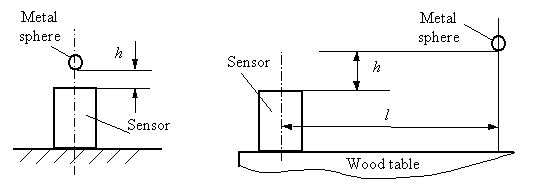

Fig. 1   Experiment arrangement (a) direct exciting on sensors; (b) exciting on the table (l=300mm)

In the first experiment a mini sphere falls directly on the sensor and excites a dynamic vibration/shock to the sensor (see Fig. 1a). The vibration of sensor increases with the height of the exciting sphere. Fig. 2 shows the maximal amplitude of oscillation signals as function of the height h. A sensor output signal greater than 700mV can be generated by a 50mg metal sphere from the height of 30mm.
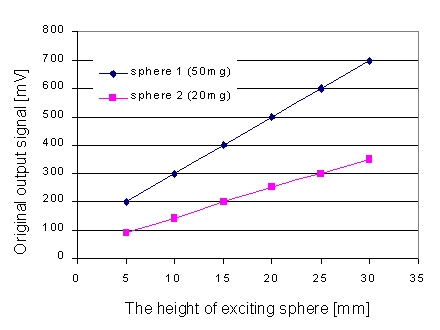
Fig. 2   Sensor output signal generated by a direct exciting on sensors with a mini sphere

Fig. 3 shows results from the second experiment. In this experiment a mini sphere falls down on a table (see Fig. 1b). The distance between the exciting point and sensor is 300mm. The exciting vibration/shock is transferred through the table to the sensor and detected by the sensor. The sensor is also very sensitive in this case.
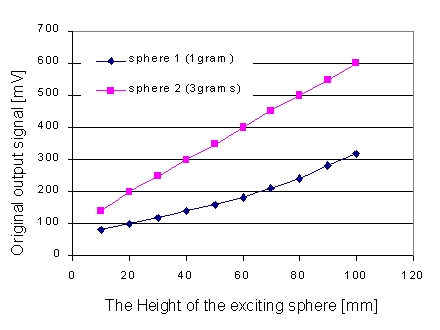
Fig. 3   Sensor output signal generated by a indirect exciting on a table with a sphere


ISO9001:2015
©
Technologies GmbH & Co. KG
Markt Schwabener Str. 8
85464 Finsing, Germany
Tel.: +49-(0)8121-2574100
Fax: +49-(0)8121-2574101
Email: info@chenyang.de
http://www.chenyang.de
 
Quality Management Manual
Delivery & Payment
General terms and conditions
Legal Notice
Disclaimer
Data Protection